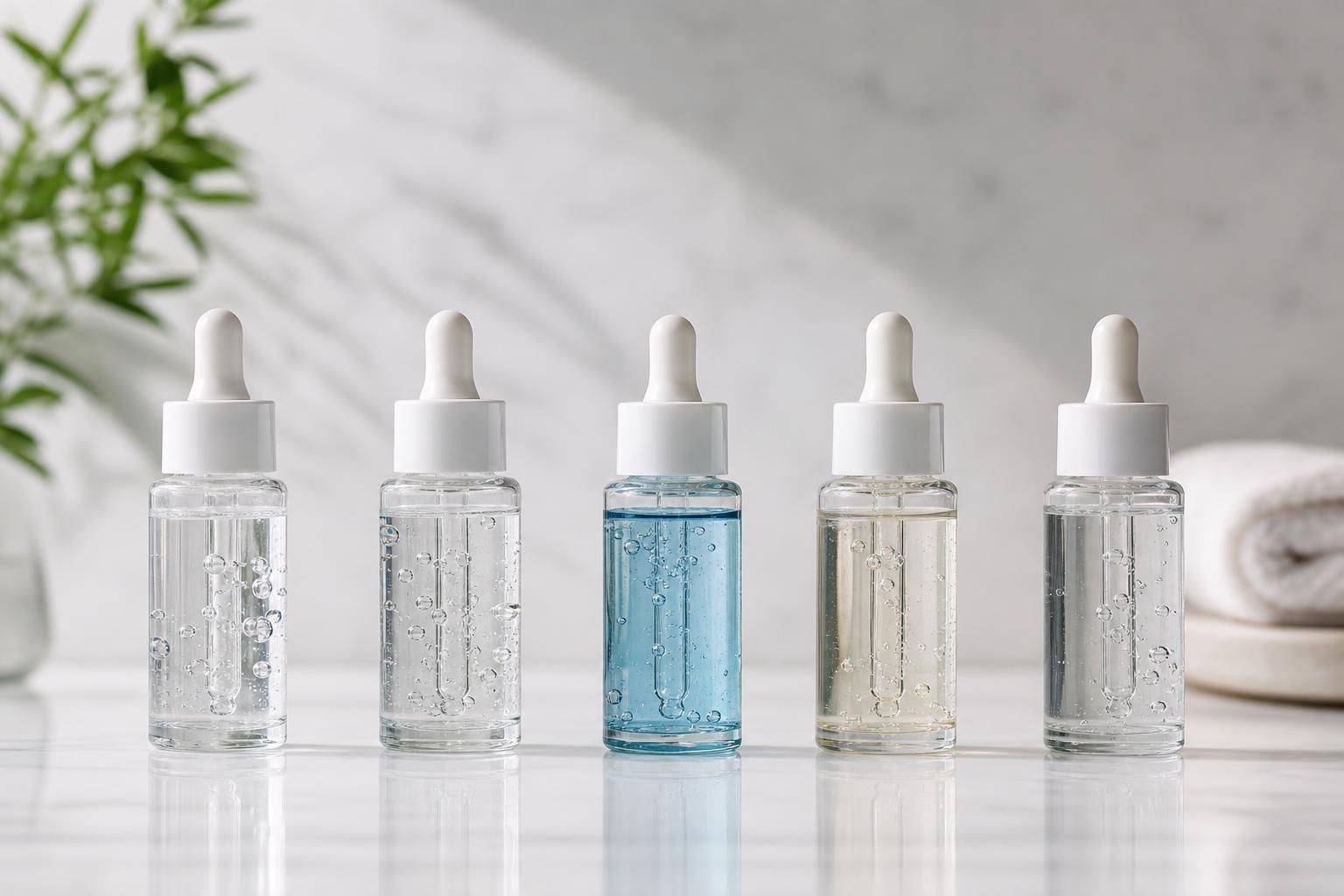
What Actually Differs Between Two Hyaluronic Acid Serums
Line up three hyaluronic acid serums and the labels say close to the same thing: hydrating, plumping, suitable for all skin types, hyaluronic acid near the top of the list. Once the marketing copy cancels out, price is the only number left that visibly differs, and price is a poor proxy for formula quality.
There are five variables that genuinely separate one HA serum from another:
- Molecular weight range. Whether the formula uses high molecular weight HA, low molecular weight fragments, or a blend of several.
- The form of HA used. Sodium hyaluronate, hydrolyzed hyaluronic acid, sodium acetylated hyaluronate and hyaluronic acid crosspolymer behave differently in a formula and feel different on skin.
- Total humectant load beyond HA. Glycerin, panthenol, betaine, urea and amino acids often do as much hydrating work as the HA itself.
- The base the HA sits in. A water-only base dries down fast and flat. A base with emollients leaves something on the surface.
- Packaging. Dropper, pump or airless bottle, which changes dosing accuracy and air exposure over the life of the product.
Notice that “percentage of HA” is not on that list as a standalone signal. A stated percentage tells you nothing about which molecular weights make up that percentage, which form of HA was used, or what else is in the bottle supporting it. Two serums at the same stated percentage can feel and perform nothing alike.
Molecular Weight: The One Spec Worth Asking About
The basic distinction is size. Higher molecular weight hyaluronic acid tends to stay on the surface and form a film that holds water at the top layer. Lower molecular weight fragments are physically smaller and can move further into the stratum corneum.
There is published work that looked at this directly. Essendoubi and colleagues, in “Human skin penetration of hyaluronic acid of different molecular weights as probed by Raman spectroscopy,” published in Skin Research and Technology in 2016, used Raman spectroscopy to track HA of different sizes in human skin. In this study, and at the molecular weights tested, low molecular weight HA (roughly 20 to 300 kDa) passed through the stratum corneum, while the high molecular weight HA tested (roughly 1000 to 1400 kDa) did not.
Read that for exactly what it is. It is a penetration measurement. It is not a measurement of wrinkle reduction, not a measurement of long term hydration, and not evidence that smaller HA is better for your skin. Depth is not the same thing as benefit, and a single study at specific molecular weights does not settle the question for every serum or every person.
The usable takeaway for a buyer is simpler. A brand that publishes its molecular weight range, or confirms it when you ask, has given you something concrete to compare across products. A brand that will not answer is asking you to choose based on the bottle.
Here is a message you can send to any brand’s support address:
Hello. I am comparing hyaluronic acid serums and I would like two specifics about your serum: the molecular weight range (or ranges, if it is a blend) of the hyaluronic acid used, and the form on the INCI list (sodium hyaluronate, hydrolyzed hyaluronic acid, sodium acetylated hyaluronate, crosspolymer, or a combination). Thank you.
Reading an HA Serum Ingredient List in Under Two Minutes
INCI lists run in descending order of concentration down to 1 percent, after which order is at the formulator’s discretion. Sodium hyaluronate is used at low concentrations by nature, so it usually appears in the lower half of the list even in a serum built around it. Seeing it sit after the preservative is normal, not a red flag.
Its position relative to other ingredients tells you more than a front-of-bottle percentage, because it shows you what the HA is suspended in and what else is carrying the hydration load.
Look for the supporting humectants: glycerin, panthenol, betaine, urea, and amino acids such as sodium PCA. HA is rarely the only hydrating agent doing work in a well built serum, and a short list with HA and little else is not automatically a stronger product.
Then look for the additions that change who the product suits:
- Fragrance or essential oils, which some people with reactive skin prefer to avoid.
- Alcohol denat. high in the list, which changes the dry-down and can feel stripping on already dehydrated skin.
- High concentrations of active acids combined into the same bottle, which turns a hydrating step into an exfoliating one and limits where it can sit in your routine.
Finally, consider the base. A water-thin serum needs a moisturizer over it to hold anything in place. A serum with emollients in the base may stand on its own for some skin types, or may be too much layered under a rich cream.
Why the Same Serum Performs Differently in Different Rooms
Humectants work by binding water. The water available to them comes from two places: the moisture already in your skin, and the humidity in the air directly above it.
In dry indoor air, heated apartments, aircraft cabins and arid climates, there is less water in the air to draw on. This is the reason formulators and dermatologists commonly advise sealing humectants under something occlusive or emollient. Applied alone in dry conditions, a humectant layer can dry down and feel tight rather than comfortable.
The fix is a change in application, not a change in product. Apply the serum to skin that is still damp from cleansing or from a hydrating toner, then apply a moisturizer with occlusive or emollient content within about a minute, before the serum has fully dried.
If you have tried an HA serum and concluded it did nothing, this sequencing issue is worth ruling out before you blame the formula.
A Two Week Test You Can Run on Any Serum
Instead of trusting a roundup, run a controlled test on your own face. Keep the same serum and the same moisturizer for the full two weeks, introduce no other new products, and either use the serum on one side of the face only or run one two week block with it against a block without it.
Decide in advance what you are observing:
- Tightness in the minutes after cleansing.
- How makeup sits by midday, particularly whether it clings to dry patches.
- Flaking around the nose, brows and hairline.
- How skin feels after a full night in a heated or air conditioned room.
Photograph in the same light at the same time of day, because recall over two weeks is unreliable and small changes are easy to talk yourself into.
Set the expectation honestly. Surface hydration changes tend to show up quickly. Anything involving fine lines operates on a much longer timeline, and a two week test cannot answer that question.
If your skin is reactive, patch test first: apply a small amount to the inner forearm or just behind the jaw once daily for several days and check for redness, itching or bumps before going to the full face.
Comparing Cost Honestly: Price Per Bottle Versus Price Per Use
Divide the price by the number of millilitres to get cost per millilitre. Then estimate how much you actually use per application, in drops or pump presses, and work out roughly how many applications a bottle holds. That is the only way to compare a small expensive bottle against a large cheap one.
Dispenser type changes the real cost. Droppers invite overuse because it is hard to measure a consistent dose, and they return unused product and air to the bottle each time. A pump delivers a repeatable amount and limits air exposure.
Shelf life matters too. A large bottle used twice daily is better value than the same bottle used twice a week, because the second one is more likely to reach the end of its recommended period after opening with product still in it.
What a Hyaluronic Acid Serum Will Not Do
HA is a hydrator. On its own it is not a barrier repair agent, not an acne treatment, and not a substitute for sunscreen.
It also helps to separate two conditions that get used interchangeably. Dehydrated skin lacks water and generally responds well to humectants with an occlusive layer over them. Dry skin lacks lipids, and the ingredients that address it are ceramides, fatty acids and cholesterol, not more HA.
If your skin is tight and dull but feels fine with a hydrating serum under a cream, a hyaluronic acid serum is a reasonable buy. If your skin flakes regardless of hydration, stings when you apply products, or has been reactive since a course of actives or a procedure, a barrier repair moisturizer is the better first purchase, and a hyaluronic acid serum can come later.
If irritation persists, flaking does not resolve, or you suspect a barrier injury, see a dermatologist rather than adding more serums to the routine.
How to Evaluate the Lumen Skincare Serum With This Checklist
The same checklist applies to our own product, and we would rather you run it than take our word for the result.
Check the HA form and the full INCI list on the product page, and read where sodium hyaluronate sits relative to the other humectants in the formula. Check the bottle size and dispenser type against your own usage so you can calculate cost per application rather than comparing bottle prices. If you want the molecular weight range before you buy, use the email script above and send it to us.
For layering, treat it as a water-phase step: apply to clean, still-damp skin, before oils and before moisturizer, and follow within about a minute with a moisturizer that contains occlusive or emollient ingredients. Sunscreen goes last in the morning.
If something on this list is not answered to your satisfaction on the page, that is a fair reason to not buy. Read the full ingredient list on the product page, or contact us directly with formulation questions.